In This Article
There’s a moment every fragrance lover knows well. You catch a whiff of something on a stranger — rich, warm, woody — and you think: what is that? Maybe it’s oud. Maybe it’s cedarwood layered over amber. Maybe it’s sandalwood so smooth it feels like cashmere for your nose. But here’s the real question, the one this article is going to answer honestly: does that bottle cost $60 or $600, and does the price difference actually matter?
Welcome to the great debate in the world of niche vs designer woody perfumes. On one side: the big luxury houses — Dior, Tom Ford, Creed — with their global distribution, billboard campaigns, and centuries of brand heritage. On the other: the artisan niche houses — Le Labo, Byredo, Diptyque — operating like small-batch distilleries, obsessing over raw ingredients and blending philosophies that most people have never even heard of.
In the woody fragrance category specifically, this debate gets interesting. Woody scents — cedarwood, sandalwood, oud, vetiver, guaiac wood — are the great equalizers. They form the backbone of some of the most expensive perfumes on earth and some of the most surprisingly affordable ones. The real difference isn’t always in the bottle. Sometimes it’s in the ideology behind it.
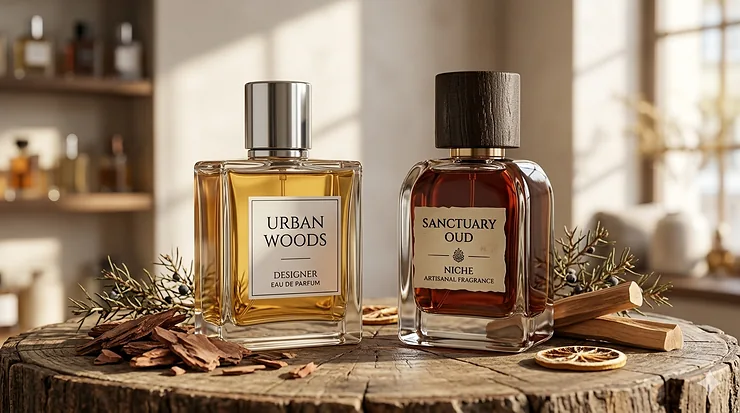
So what exactly are we talking about when we compare niche vs designer woody perfumes? Niche fragrances are produced by independent perfume houses that prioritize creative vision and raw ingredient quality over mass-market appeal. Designer fragrances, by contrast, are created by fashion and luxury brands with enormous production scales, global retail networks, and mainstream audiences. Both categories produce extraordinary woody scents — and both can disappoint you spectacularly if you buy blind.
This guide will save you from expensive mistakes, walk you through 7 of the best woody fragrances currently available on Amazon, and give you the honest framework to decide which side of the fence is right for your nose, lifestyle, and budget.
Quick Comparison: Niche vs Designer Woody Fragrances at a Glance
| Feature | Niche Woody Fragrances | Designer Woody Fragrances |
|---|---|---|
| Price Range | $150–$500+ | $60–$300 |
| Ingredient Quality | Ultra-premium, often single-origin | High-quality, IFRA-compliant blends |
| Sillage & Longevity | Variable (concentration-dependent) | Consistent, engineered for performance |
| Uniqueness | High — limited production runs | Lower — mass-produced for broad appeal |
| Risk of Blind Buy | High | Lower |
| Best For | Fragrance collectors, personal expression | Daily wear, compliment-getters, gifting |
| Availability | Specialty boutiques, brand websites, Amazon | Widely available, department stores |
The table above tells a story that the perfume marketing world doesn’t want you to hear: neither category is objectively superior. Niche wins on artistry and ingredient depth; designer wins on consistency and accessibility. But here’s the insight most buyers overlook — the best investment-worthy woody perfumes often live in the overlap between these worlds. Tom Ford’s Private Blend line, for example, practically lives on the border. Creed straddles the line so effectively that the fragrance community debates its classification constantly.
💬 Just one click — help others make better buying decisions too! 😊
Top 7 Niche vs Designer Woody Perfumes: Expert Analysis
1.Le Labo Santal 33 Eau de Parfum— The Cult Classic That Changed Everything
If woody fragrances had a Hall of Fame, Santal 33 would be the first inductee. Launched in 2011 by indie New York house Le Labo, this iconic unisex scent built around Australian sandalwood, cedarwood, papyrus, and a whisper of leather has become one of the most recognized niche fragrances on the planet.
The specs in plain English: The EDP format means you’re working with a higher fragrance concentration — typically 15–20% — which translates to genuine all-day wear from two or three sprays. The sandalwood here isn’t the creamy, sweet variety you’d find in a drugstore body lotion. It’s dry, slightly smoky, almost crackling — like an open fire fading into warm wood ash. The cardamom and iris keep it from feeling heavy, while ambrox gives it that skin-like intimacy that makes it feel personal rather than perfumey.
Who should buy this: Anyone who wants to smell genuinely distinctive in a room full of Sauvage wearers. Santal 33 is for people who understand that smelling unique is a form of personal branding. It’s also a legitimate status symbol in fragrance circles — wearing it communicates taste without effort. That said, it’s polarizing. Some people find the smokiness aggressive. The spec sheet won’t tell you this, but the first 30 minutes on skin can catch you off guard before it settles into something deeply beautiful.
What customers say: Buyers consistently praise its remarkable versatility — genuinely wearable year-round — and its ability to generate compliments from people who “can’t usually tell what fragrance is.” The most common criticism? The price-per-ml ratio is brutal, and performance varies significantly depending on skin chemistry and hydration levels.
✅ Truly unique, instantly recognizable profile
✅ Unisex — works beautifully on all skin types
✅ Le Labo’s iconic minimal-luxe packaging
❌ Performance can be underwhelming on very dry skin
❌ High price point for the concentration offered
Available on Amazon in 30ml and 50ml sizes. Check current pricing and availability — price ranges sit in the $200–$350 range depending on size.
2. Tom Ford Oud Wood Eau de Parfum — The Bridge Between Worlds
Tom Ford’s Private Blend collection launched in 2007 and Oud Wood was its statement piece. It remains, nearly two decades later, one of the most influential woody fragrances ever created. This is the bottle that introduced mainstream Western audiences to oud — the prized resin extracted from infected agarwood trees, sometimes called “liquid gold” for good reason.
The specs in plain English: Oud Wood layers rare oud over rosewood, cardamom, sandalwood, vetiver, and amber. The oud used here is approachable — not the barnyard intensity of raw Middle Eastern oud, but a smoother, rounder interpretation that makes the material accessible without dumbing it down. The vetiver and sandalwood base gives it incredible longevity; this is the kind of fragrance that still whispers from your shirt collar the next morning.
Who should buy this: The executive who wants a power scent. The fragrance enthusiast who’s been circling niche territory but wants a safer landing. The person who wants to smell genuinely expensive without explaining a bottle no one has heard of. Oud Wood is also exceptional value for what it delivers — yes, it sits in the $200–$280 range for 50ml, but the ingredient quality and performance justify every dollar in a way that cheaper oud fragrances simply cannot.
What customers say: Reviewers across Amazon praise its magnetic quality and the frequency of unsolicited compliments. Multiple buyers describe it as their “most-complimented fragrance ever,” which is remarkable for something this sophisticated. The occasional criticism centers on reformulation concerns — earlier batches from 2007–2014 were considered significantly stronger.
✅ Sophisticated, genuinely complex oud interpretation
✅ Exceptional longevity — 10+ hours on skin
✅ Works across seasons and dress codes
❌ Reformulation has reportedly reduced projection vs early batches
❌ Premium price point may be steep for casual buyers
Available on Amazon in 50ml Private Blend bottles. Prices typically land in the $200–$280 range.
3. Creed Royal Oud Eau de Parfum — The Aristocrat of Woody Fragrances
Few houses carry the weight of history that Creed does. Founded in 1760, the house has supplied fragrance to European royals for centuries — and Royal Oud, launched in 2011, wears that heritage visibly. This is a woody fragrance built around the architecture of a Persian palace: oud, cedarwood, pink pepper, grapefruit, cardamom, and lemon.
The specs in plain English: What makes Royal Oud different from typical oud-forward fragrances is its extraordinary luminosity. Most oud perfumes push you toward darkness and heaviness. Royal Oud pulls toward light — the grapefruit and cardamom top notes create a sparkling, almost citrus-bright opening that gradually reveals a dry, noble wood base. The oud itself is the rare Assam variety, sourced from India, and its quality is genuinely apparent to anyone who has spent time exploring this ingredient. The cedar base provides structure without stiffness.
Who should buy this: People who find most oud fragrances too aggressive or medicinal. Royal Oud is the entry point for oud exploration — elegant, approachable, and unmistakably prestigious. It’s also worth noting that this fragrance reads as genuinely unisex in the best sense. Women who discover it often love it just as much as the men it’s ostensibly marketed to.
What customers say: Customers consistently describe it as their most-reached-for fragrance for important occasions — first dates, interviews, client meetings. The projection gets praised universally. The criticism most commonly raised? The 100ml bottles are expensive enough to feel like a commitment purchase.
✅ Luminous, sophisticated interpretation of oud
✅ True unisex appeal with broad compliment-earning power
✅ 250+ years of Creed house legacy in every bottle
❌ Very high price point ($300–$450 range for 100ml)
❌ Dry-down can feel linear after the complex opening
Available on Amazon in 50ml and 100ml options. The 50ml typically sits in the $250–$320 range.
4. Maison Margiela Replica “By the Fireplace” Eau de Toilette — The Democratic Woody
Not every great woody fragrance needs to cost $300. Maison Margiela’s Replica line is built around a brilliant concept: instead of fabricating some mythological luxury experience, why not recreate a real memory? By the Fireplace, launched in 2015, recreates exactly that — the warm, smoky, sweet-edged atmosphere of sitting beside a crackling fire on a cold winter night.
The specs in plain English: The formula pairs guaiac wood and cashmeran (a synthetic that beautifully mimics woody smokiness) with clove oil, chestnut accord, vanilla, and red berries. The guaiac wood is the engine here — it provides a dry, slightly resinous smokiness that reads as genuine wood rather than synthetic approximation. The vanilla and chestnut stop it from ever feeling harsh or cold. This is a warm woody, emphatically cozy rather than austere. In EDT concentration, it sits lighter on skin than its niche competitors, but that’s appropriate for its intended mood — this isn’t a power fragrance, it’s a comfort fragrance.
Who should buy this: First-time woody fragrance buyers who find pure oud intimidating. Anyone looking for a reliable fall and winter scent that generates conversation. The designer fragrance enthusiast who appreciates niche concepts but can’t justify niche pricing just yet. By the Fireplace is also arguably the best entry-level test for your own taste: if you love this, you’re almost certainly ready to explore guaiac wood and woody amber territory in niche territory.
What customers say: Over a thousand Amazon reviewers consistently describe the longevity as surprisingly impressive for an EDT. The most recurring phrase: “everyone asks what I’m wearing.” One reviewer called it “niche quality at designer prices” — which is exactly the point.
✅ Outstanding concept-to-execution ratio
✅ Universally approachable and compliment-earning
✅ Excellent value in the $80–$110 range for 100ml
❌ EDT format means lighter projection vs EDP competitors
❌ Can feel season-specific — heavy in summer heat
Available directly on Amazon in multiple sizes including 30ml and 100ml.
5. Diptyque Tam Dao Eau de Parfum — The Meditative Sandalwood
Paris-based Diptyque has been making some of the most quietly excellent fragrances in the world since the 1960s — decades before “niche” was even a category. Tam Dao, first launched in EDT in 2003 and reformulated as an EDP in 2013, is their definitive woody statement. Named after the Tam Đảo mountain range in northern Vietnam, it distills sandalwood with cedar, amberwood, coriander, musk, lime, vanilla, and ginger.
The specs in plain English: The EDP version is meaningfully different from the EDT — denser, warmer, with the sandalwood more prominently creamy and the cedar more dry and structural. Sandalwood from Goa, India is the centerpiece, and the quality is conspicuous to anyone who knows what real sandalwood smells like (most mass-market “sandalwood” fragrances bear very little resemblance to the actual material). The ginger and lime in the opening prevent it from reading as heavy or old-fashioned, while the amber base keeps things warm for hours. Expect 6–8 hours of genuine wear in most conditions.
Who should buy this: The minimalist who finds most woody fragrances too loud, too complex, or too aggressive. Tam Dao is a meditation, not a statement — it rewards the wearer more than it signals to onlookers. It’s also exceptional for office environments, where woody fragrances can sometimes push into overpowering territory. Think of it as the intelligent introvert of this roundup.
What customers say: The most consistent praise centers on its ability to work in any context — professional settings, casual weekends, even summer if you apply sparingly. Some buyers note that longevity, while solid in EDP form, can still feel brief on very dry skin.
✅ Genuinely beautiful use of real sandalwood
✅ Office-safe, season-versatile, effortlessly elegant
✅ Understated niche credibility at $150–$200 per 75ml
❌ Not a projection beast — stay-close rather than fill-a-room
❌ May feel “simple” to buyers who prefer complexity
Available on Amazon in EDT and EDP formats, typically in the $120–$200 range.

6. Byredo Gypsy Water Eau de Parfum — The Bohemian Forest
Swedish house Byredo has built a devoted following by making fragrances that feel like stories — and Gypsy Water, launched in 2008, remains its most beloved chapter. Inspired by the nomadic Romani people and the natural world they moved through, it combines pine needles, juniper, bergamot, pepper, incense, orris root, sandalwood, vanilla, and amber.
The specs in plain English: Gypsy Water is a woody-aromatic rather than a pure wood fragrance — there’s a distinctly foresty, almost green quality to its opening that comes from the pine needles and juniper. It smells like standing inside a forest after rain. The incense mid-note is restrained enough to feel spiritual rather than churchy. Then the sandalwood and vanilla base arrive in the dry-down, and the whole composition warms up into something genuinely captivating. The performance is a known weakness — this is a fragrance that stays close to your skin rather than projecting outward, and on some wearers, it fades faster than you’d hope for the price.
Who should buy this: The creative professional. The traveler. Someone who wants a fragrance that functions more like a personal mood than a public statement. Gypsy Water is about feeling rather than impression — wear it when you want to feel grounded, present, slightly mysterious. It’s also one of the best gateway fragrances into niche territory precisely because it doesn’t smell “perfumey” in the conventional sense.
What customers say: Fans describe it as deeply personal — “the fragrance I wear for myself, not for compliments.” The primary complaints cluster around performance: projection is modest, longevity is often around 4–6 hours, and some buyers feel that the price-per-wear ratio doesn’t hold up against other options in this list.
✅ Uniquely evocative, genuinely artistic concept
✅ Unisex, effortlessly cool, conversation-starting
✅ One of the most copied fragrances in indie perfumery (a real compliment)
❌ Projection and longevity underwhelm for the price point
❌ Blind buy risk is genuinely high
Available on Amazon via authorized sellers, typically in the $190–$240 range for 100ml EDP.
7. Dior Sauvage Eau de Parfum — The Woody Designer Heavyweight
No list comparing niche vs designer woody perfumes can ignore Dior Sauvage. It’s the best-selling men’s fragrance on earth — a title it has held for years — and the EDP version specifically deserves its reputation as one of the most polished woody designer fragrances ever created.
The specs in plain English: Sauvage EDP is anchored by ambroxan (a molecule derived from ambergris that creates an extraordinarily powerful skin-like warmth) layered over cedarwood, sichuan pepper, lavender, and geranium. The woody character here comes primarily from ambroxan and cedarwood rather than traditional lumber notes — it’s a smoky, warm wood rather than a crisp or green one. This distinction matters: if you want the smell of an actual forest, look elsewhere. If you want the smell of masculinity distilled into a chemical formula, Sauvage EDP is unmatched. Longevity is outstanding — expect 12+ hours on skin, with the ambroxan base lingering well into the following morning on clothing.
Who should buy this: Anyone who wants maximum compliments with minimum effort. The office worker who sprays once and forgets about it. Someone new to fragrance who wants a reliable, universally praised starting point before exploring niche territory. Sauvage EDP is, essentially, the reliable daily driver — it’s the fragrance equivalent of a well-made German sedan: not the most exciting thing in the world, but it will never let you down, and everyone respects it.
What customers say: The compliments are relentless — multiple Amazon buyers describe strangers following them to ask what fragrance they’re wearing. Fragrance enthusiasts occasionally dismiss it as “too mainstream” or “ubiquitous,” but that criticism says more about snobbishness than scent quality.
✅ Best-in-class longevity and projection
✅ Universal compliment-earner — difficult to go wrong
✅ Approachable $80–$130 range for 100ml EDP
❌ Very common — you will smell this on other people
❌ Ambroxan-heavy formula may cause sensitivity in some wearers
Available widely on Amazon in EDT, EDP, and Elixir concentrations.
✨ Don’t Miss These Exclusive Deals!
🔍 Ready to find your next signature woody scent? Click on any highlighted product above to check current pricing and availability. Whether you’re investing in a niche masterpiece or grabbing a trusted designer classic, the right woody fragrance can genuinely change how you move through the world.
How to Choose Between Niche and Designer Woody Fragrances: A Practical Guide
The fragrance industry wants to sell you on mythology. The niche world wants you to believe that designer fragrances are soulless corporate products. The designer world subtly implies that niche is just expensive weirdness. Neither is entirely true. Here’s a framework that actually works:
Step 1: Define your use case first. Daily wear, special occasions, and signature scents are three completely different briefs. For daily wear, a reliable designer woody (Sauvage EDP, Dior’s whole lineup) makes total sense — you want something consistent, inoffensive in close quarters, and affordable enough to use liberally. For special occasions, niche territory opens up: Creed Royal Oud or Le Labo Santal 33 carry a weight that feels appropriate for important moments.
Step 2: Assess your tolerance for risk. Niche fragrances are a gamble. Byredo Gypsy Water smells extraordinary on some skin types and nearly nothing on others. Le Labo Santal 33 divides rooms. If you’re a blind-buy buyer, designer woods are safer. If you have access to samples — and Amazon sample listings make this easier than ever — niche exploration becomes much lower risk.
Step 3: Understand what “quality” actually means. More expensive does not automatically mean better. What premium niche pricing often buys you is ingredient specificity — not just “sandalwood,” but Goa sandalwood. Not just “oud,” but Assamese oud harvested at a specific stage of resin development. Whether that specificity matters to your nose is a genuinely personal question that only wearing the fragrance can answer.
Step 4: Consider longevity vs concentration. The concentration hierarchy — EDC, EDT, EDP, Parfum — matters enormously for woody fragrances. Woods are base notes, meaning they’re inherently persistent, but lower concentrations can still underperform in cold weather or on dry skin. Always factor concentration into your price-per-wear calculation.
Step 5: Think about uniqueness vs universality. This is the core niche vs designer woody perfumes question. Do you want to smell unique, or do you want to smell great? These aren’t mutually exclusive, but they’re different priorities. Niche optimizes for the former; designer tends to optimize for the latter.
Real-World Scenarios: Which Woody Fragrance Fits Your Life?
Let’s get specific — because generic advice about fragrance is almost useless.
The Young Professional (Budget: $80–$130, Needs: Daily wear + compliments). Start with Dior Sauvage EDP or Maison Margiela By the Fireplace. Both perform reliably, both earn compliments without effort, and neither requires fragrance literacy to enjoy. Sauvage is more versatile across seasons; By the Fireplace is more distinctive and cozy in fall and winter specifically.
The Fragrance Enthusiast (Budget: $150–$250, Needs: Something to talk about). Diptyque Tam Dao EDP or Byredo Gypsy Water. Both offer genuine niche artistry at price points that don’t feel like financial commitments. Tam Dao rewards those who prefer restraint and elegance; Gypsy Water suits those who want something more atmospheric and foresty.
The Serious Collector (Budget: $250+, Needs: Investment-worthy quality ingredients). Le Labo Santal 33, Tom Ford Oud Wood, or Creed Royal Oud. These are the fragrances where ingredient sourcing, house philosophy, and genuine perfumery craft converge. Santal 33 is the most culturally significant; Oud Wood is the most approachable bridge into luxury oud; Royal Oud is the most prestigious daily driver if money isn’t the determining factor.
The Gift Buyer (Budget: flexible, Needs: Impressive but safe). Tom Ford Oud Wood is arguably the perfect gift in this category — name recognition that communicates luxury, a scent profile that reads as sophisticated rather than niche-challenging, and availability on Amazon with reliable shipping. By the Fireplace is the right call for a cozy autumn gift.

Common Mistakes When Buying Woody Fragrances
Fragrance buyers — even experienced ones — repeat the same errors. Here are the five most expensive ones, and how to avoid them:
Mistake 1: Testing on paper. Woody fragrances are built on base notes that require skin contact, body heat, and time to develop. A paper strip will tell you nothing useful about how a sandalwood or oud will smell on you after an hour. Always test on your wrist, wait 30 minutes, then decide.
Mistake 2: Buying for the top note. That opening blast of pepper, citrus, or bergamot you smell in the first five minutes? It’ll be gone within the hour. Woody fragrances live in their dry-down. Buy Sauvage EDP or Creed Royal Oud for the base, not the opening.
Mistake 3: Assuming niche automatically means better performance. Byredo Gypsy Water is a masterpiece, but it has notoriously modest projection. Le Labo Santal 33 can fade faster than Dior Sauvage on the same skin. Performance is about molecular weight and concentration, not brand prestige.
Mistake 4: Ignoring skin chemistry. Sandalwood, in particular, interacts dramatically with individual body chemistry. The creamy, soft sandalwood on one person becomes sharp and almost sour on another. This isn’t a product quality issue — it’s biochemistry. Samples exist for a reason.
Mistake 5: Conflating price with investment value. A $300 bottle you wear twice has worse ROI than an $85 bottle you reach for every day. The most investment-worthy woody perfume is the one that matches your actual lifestyle, not your aspirational one.
Niche vs Designer Woody Perfumes: Ingredient Quality Compared
This is where the conversation gets genuinely interesting — and where fragrance marketing most frequently misleads buyers. According to research published by the International Fragrance Association (IFRA), both niche and designer fragrances must comply with the same safety regulations regarding ingredient concentrations. But compliance thresholds and ingredient selection are two very different things.
Designer fragrances at the mass-market level typically use the most cost-effective version of any given woody ingredient. “Cedarwood” in a $40 fragrance is almost certainly Virginian cedarwood oil — reliably pleasant, commercially available, technically accurate. “Cedarwood” in a premium niche fragrance might be Atlas cedarwood, Lebanese cedarwood, or a single-origin Himalayan variety, each with distinct aromatic profiles. According to Fragrantica’s research database, oud — arguably the defining luxury woody material — can range from a few dollars per kilogram for synthetic approximations to over $5,000 per kilogram for premium-grade wild agarwood oil. That price gap explains a lot about why Creed Royal Oud costs what it does.
Sandalwood tells a similar story. According to the Sandalwood Association, genuine Mysore sandalwood from India — the historical gold standard — commands extraordinary premiums due to government restrictions on harvesting. Alternatives like Australian sandalwood (used by Le Labo in Santal 33) and synthetic sandalol molecules (widely used in mass-market products) provide different aromatic characters at vastly different price points.
The practical takeaway: at the $150+ price point in niche, you are frequently paying for genuinely better raw materials. Below that threshold, and particularly in mainstream designer territory, you’re paying more for brand equity than ingredient quality. Neither is wrong — it just matters that you know what you’re actually buying.
Long-Term Value: What Does a Woody Fragrance Actually Cost Per Wear?
Fragrance buyers rarely do this math. They should.
| Fragrance | Price Range (100ml) | Estimated Sprays | Cost Per Spray |
|---|---|---|---|
| Dior Sauvage EDP | $100–$130 | ~1,300 | ~$0.09 |
| Maison Margiela By the Fireplace | $80–$110 | ~1,300 | ~$0.07 |
| Diptyque Tam Dao EDP | $160–$200 | ~1,300 | ~$0.14 |
| Byredo Gypsy Water EDP | $190–$240 | ~1,300 | ~$0.17 |
| Le Labo Santal 33 EDP | ~$350 (100ml) | ~1,300 | ~$0.27 |
| Tom Ford Oud Wood EDP | ~$280 (50ml equiv) | ~650 | ~$0.43 |
| Creed Royal Oud EDP | $300–$450 | ~1,300 | ~$0.31 |
What this table makes clear is that Sauvage and By the Fireplace are by far the most economical options per wear. But here’s the interpretation that matters: if you’re choosing between a $350 bottle of Santal 33 that you’ll reach for 400 times over two years versus a $110 bottle of something you find boring and wear 30 times, the numbers flip dramatically. Buy the fragrance that makes you want to wear it. That’s the real cost-per-wear optimization.
The second insight: Tom Ford Oud Wood looks expensive per spray because 50ml bottles are smaller, but many buyers find 2 sprays sufficient given the concentration and longevity. At 2 sprays per wear, you’re looking at 325 wears per bottle — and if this becomes your signature fragrance, that’s easily 2–3 years of daily use. The math becomes considerably more reasonable.
Features That Actually Matter in Woody Fragrances (And Those That Don’t)
The fragrance industry is extraordinarily good at marketing things that don’t actually improve the scent experience.
Matters enormously: The concentration (EDT vs EDP vs Parfum). Wooden structures and oud resins develop completely differently at different concentrations. The EDP version of a fragrance is almost always a meaningfully different experience from the EDT, not just a stronger version of the same thing.
The ingredient source. As covered above — where the sandalwood, oud, or cedarwood comes from changes the character of the fragrance fundamentally.
Matters somewhat: Bottle design. It affects the perceived value of gifting and the shelf aesthetic, but it contributes zero to the actual fragrance experience. Le Labo’s utilitarian brown-label apothecary bottles are unfussy by design; Creed’s green glass is beautiful but serves the marketing as much as the fragrance.
Doesn’t matter: The celebrity who fronts the campaign. The country the bottle was “inspired by.” Whether the bottle is refillable. None of these affect what’s inside.
What most buyers overlook: the atomizer quality in premium fragrances is significantly better than in cheaper alternatives. A poorly calibrated spray nozzle delivers inconsistent amounts and degrades the top note experience, which is more of a problem than most buyers realize until they’ve used a properly calibrated high-end atomizer.

FAQ
❓ Is niche perfume really better than designer?
❓ Which niche vs designer woody perfume lasts the longest?
❓ Are niche woody fragrances worth the investment?
❓ What's the best woody perfume for beginners?
❓ Can woody fragrances work for women?
Conclusion
The debate between niche vs designer woody perfumes doesn’t have a winner. It has a truth: different fragrances serve different moments, and the best collection contains both.
If you’re starting out, Dior Sauvage EDP or Maison Margiela By the Fireplace will serve you remarkably well — proven performers, genuine quality, and price points that don’t require courage to commit. As your nose develops — and it will, faster than you expect — Diptyque Tam Dao and Byredo Gypsy Water offer increasingly sophisticated experiences that reward attention and patience.
When you’re ready for the top shelf, Tom Ford Oud Wood is the most accessible gateway into genuinely premium oud territory. Le Labo Santal 33 is the definitive niche woody — a cultural artifact as much as a fragrance. And Creed Royal Oud is the bottle you reach for on the days that actually matter.
Ultimately, the most investment-worthy woody perfume isn’t the most expensive one or the most prestigious one. It’s the one that makes you pause when you catch it on yourself. The one that makes strangers turn. The one that smells, without question, like you.
✨ Ready to find yours?
Click on any highlighted fragrance above to check current Amazon pricing and availability. Your signature scent is closer than you think.
Recommended for You
- Tobacco vs Leather Fragrance: 7 Best Picks Reviewed (2026)
- Cedarwood vs Sandalwood Cologne: 7 Best Picks That Actually Work (2026)
- Gardenia vs Tuberose Perfume: 7 Best Picks to Choose in 2026
Disclaimer: This article contains affiliate links. As an Amazon Associate, I earn from qualifying purchases. If you purchase products through these links, we may earn a small commission at no additional cost to you.
✨ Found this helpful? Share it with your friends! 💬🤗
