In This Article
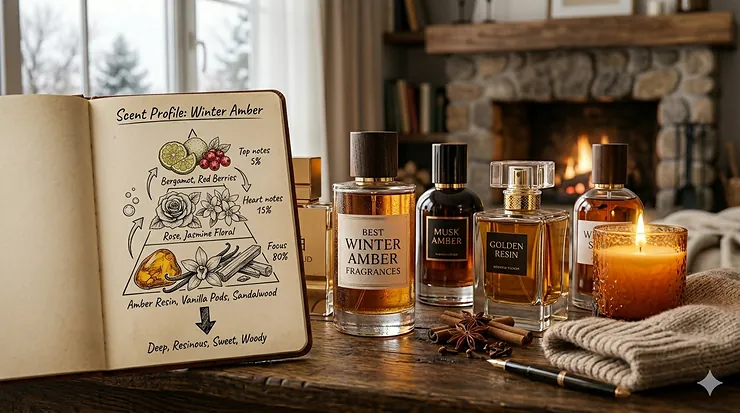
Amber is the great impostor of perfumery. There’s no amber farm, no amber distillery, no little amber spice rack at the back of a perfumer’s lab. Winter amber fragrances get their golden, resinous warmth from a blend of labdanum, benzoin, vanilla, and whatever spices a perfumer feels like throwing into the cauldron that week, and the result is a smell that doesn’t so much announce itself as settle over you like a wool blanket somebody left by the radiator.

That’s also exactly why amber owns cold weather. Citrus and aquatic scents are built for skin you can already feel; amber is built for skin you’re trying to warm back up. The minute the thermostat drops and you start fantasizing about flannel and bone broth, your nose starts craving the same thing — cinnamon, dried fruit, tonka bean, a whisper of smoke. Wear a bright, zippy fragrance in January and it just sort of evaporates into the cold, embarrassed. Wear amber, and it clings, blooms, and turns your coat into a scent diffuser for the next eight hours.
I went looking for the actual bottles people are buying on Amazon right now to wear through this exact stretch of the calendar — not the niche-counter unicorns nobody can find in stock, but real, purchasable fragrances spanning $12 roll-ons to $200 designer flacons. What follows is a comparison, seven honest reviews, and a few hard-won opinions about which “cozy winter oriental” claims are real and which ones are just marketing copy wearing a turtleneck. If you’ve been Googling cold weather amber perfumes, amber perfume for snow, or fireside warm fragrances at 11pm trying to find your signature scent before the holidays, you’re in the right place.
Quick Comparison Table: 7 Winter Amber Fragrances at a Glance
| Fragrance | Best For | Price Range | Longevity |
|---|---|---|---|
| Lattafa Khamrah | Budget gourmand lovers | $30–$38 | 6–9 hrs |
| Lattafa Ana Abiyedh Rouge | Saffron-rose fans on a budget | $20–$30 | 4–6 hrs |
| Al Haramain Amber Oud Gold Edition | Fans of fruity-amber unisex scents | $25–$40 | 6–8 hrs |
| Nemat Amber Perfume Oil | Sensitive skin, subtle wearers | $10–$18 | 5–7 hrs (skin scent) |
| Ariana Grande Cloud | Younger, mainstream gourmand fans | $45–$65 | 5–7 hrs |
| Maison Margiela Replica By the Fireplace | Niche-curious gift buyers | $120–$150 | 5–7 hrs |
| Tom Ford Tobacco Vanille | Special-occasion luxury | $200–$260 | 8–12 hrs |
Looking at the spread, the story isn’t really “cheap versus expensive” — it’s which flavor of warmth you want. The Lattafa duo and Al Haramain prove that gourmand-spice amber has been thoroughly democratized; you can buy three of those bottles for less than one ounce of Tobacco Vanille. Where the money actually buys something is dry-down complexity and projection control: Tom Ford’s tonka-cocoa base unfolds in layers for half a day, while the budget options tend to peak hard in the first few hours and then fade into a polite skin scent. If your budget tops out around $40, Khamrah is the safest first buy on this list.
💬 Just one click — help others make better buying decisions too! 😊
The 7 Best Winter Amber Fragrances — Expert Analysis
I’m sorting these roughly budget to premium, because the jump in price on this list is enormous and the jump in quality, frankly, is not always proportional.
1. Lattafa Khamrah Eau de Parfum
Lattafa Khamrah is the fragrance that made half of TikTok smell like a Moroccan spice market in 2023, and it has not slowed down since. The opening hits with cinnamon, nutmeg, and bergamot — a sharp, warm slap that softens within minutes into dates, praline, and tuberose. By hour three, you’re left with vanilla, tonka bean, and amberwood doing the heavy lifting.
What the spec sheet won’t tell you: at this price, fragrance houses usually cut corners on the base notes, since that’s the part nobody smells in-store before buying. Lattafa didn’t. The tonka-and-benzoin dry-down on Khamrah is genuinely the equal of bottles costing eight times more for the first several hours of wear, which is exactly why it has the highest repeat-purchase rate of any budget gourmand fragrance, per longtime sellers tracking the category. The fragrance has earned an 8.7 out of 10 editorial score after roughly two years of wear-testing. Where it loses ground to niche alternatives is the second half of the dry-down — it goes a little flatter and sweeter than a $300 bottle would, but most people aren’t sniffing their own wrist at hour ten anyway.
Customers consistently describe getting stopped by strangers asking what they’re wearing, with the scent compared favorably to far pricier vanilla-forward fragrances.
✅ Pros: unbeatable value, huge compliment factor, genuinely long wear.
❌ Cons: very projection-heavy (overspray at your own risk), and the opening can read as headache-inducing to a small minority of sensitive noses.
Best for: anyone who wants to understand what “cozy winter oriental” actually smells like before committing real money to the category.
Price/value verdict: at $30–$38, it’s the best dollar-for-dollar amber on this entire list.
2. Lattafa Ana Abiyedh Rouge Eau de Parfum
If Khamrah is the gourmand-spice flagship, Ana Abiyedh Rouge is Lattafa’s answer to the saffron-and-ambergris niche fragrances that retail for ten times the price. It opens with bitter almond and saffron, a top accord that’s spicier and a little sharper than most budget ambers attempt, then settles into jasmine and cedar before landing on ambergris, musk, and soft woods.
The practical translation: this is the bottle to reach for when you want amber that leans elegant and slightly sweet-salty rather than full gourmand dessert. The saffron note here isn’t true saffron — it’s an approximation, and a sharp nose will catch the synthetic edge in the first ten minutes — but it settles into something genuinely lovely once it warms on skin. Reviewers regularly compare it directly to far pricier saffron-ambergris fragrances, noting the resemblance is close enough that most people couldn’t tell the difference blind. The tradeoff for that resemblance is shorter performance: this one runs 4–6 hours rather than the all-day sillage of Khamrah, so plan on a midday reapply for long winter outings.
✅ Pros: sophisticated saffron-amber profile, layers beautifully under a coat, genuinely affordable.
❌ Cons: shorter longevity than its sibling, and the synthetic saffron note isn’t for purists.
Best for: evening wear and special occasions on a budget.
Price/value verdict: at $20–$30, it punches well above its price tier for a special-occasion bottle.
3. Al Haramain Amber Oud Gold Edition
Al Haramain Amber Oud Gold Edition takes a different route into amber: instead of spice-and-dessert, it opens fresh, with bergamot and green notes, before sweetening into melon, pineapple, and amber, then settling into woody notes, vanilla, and musk. It’s the friendliest, most “unisex office-safe” bottle on this list — genuinely wearable by anyone who finds the Lattafa duo too dessert-forward for daytime.
Here’s what that fruity opening actually does for you in practice: it buys you ten extra degrees of approachability. Where Khamrah announces itself, Amber Oud Gold Edition eases in, which makes it the better pick if you’re nervous about overwhelming a shared office or an elevator. The amber-vanilla base is real and long-lasting, even if the journey to get there is sweeter and fruitier than a purist amber fan might expect. Al Haramain has been in the Middle Eastern perfumery business since 1970, and that institutional experience shows in how well-blended this fragrance feels for the price.
✅ Pros: genuinely unisex, great daytime wearability, long-lasting base.
❌ Cons: the fruity top notes can feel like a detour if you want straight resinous amber from the first spray.
Best for: buyers who want amber that doesn’t read as heavy or aggressive.
Price/value verdict: $25–$40 across the common bottle sizes, with the 100ml typically the best per-ounce value.
4. Nemat Amber Perfume Oil
Not every winter amber needs to come out of a spray bottle, and Nemat Amber Perfume Oil is the proof. This is a pure, alcohol-free perfume oil — no denatured alcohol carrier, no sharp opening blast, just a concentrated amber accord in a jojoba-oil base that you roll directly onto pulse points.
The practical upside of skipping alcohol is real: perfume oils develop slower and stay closer to the skin, which means less projection but also far less risk of irritation for people who get headaches or rashes from alcohol-based sprays. This format suits amber specifically well, since amber is a base-note accord to begin with — it doesn’t need a fizzy top note to make an entrance, it just needs warmth and time. Reviewers frequently mention getting stopped by strangers asking what they’re wearing despite barely being able to smell it on themselves, which is the classic signature of a well-blended skin scent.
✅ Pros: gentle on sensitive skin, no overspray risk, genuinely long-lasting as a skin scent.
❌ Cons: minimal sillage if you want a fragrance that fills a room, and the tiny bottle size means more frequent reorders.
Best for: sensitive skin, minimalists, and anyone layering amber under a heavier spray fragrance.
Price/value verdict: at $10–$18 for a 10ml roll-on, it’s the cheapest entry point into the category by a wide margin, and a smart pick for first-time amber wearers nervous about commitment.
5. Ariana Grande Cloud Eau de Parfum
Ariana Grande Cloud isn’t marketed as an “amber” fragrance, and that’s worth flagging honestly — it’s positioned as a warm gourmand. But the base notes (cashmere, musk, woods) and the praline-and-vanilla heart give it enough amber-adjacent warmth that it’s earned a permanent spot in “cozy winter scent” roundups, and it’s one of the best-selling fragrances on Amazon in this general category, full stop.
What actually happens on skin: lavender blossom and pear open things up with a soft floral edge, which is unusual for this category — most winter amber scents skip florals entirely — and then it folds into whipped coconut, praline, and vanilla orchid. It reads younger and sweeter than anything else on this list, more “vanilla latte” than “fireplace,” and that’s precisely the appeal for a huge chunk of buyers who find traditional resinous amber too heavy or too “old-fashioned” smelling. It’s mass-market in the best sense: broadly flattering, easy to wear daily, and not remotely polarizing.
✅ Pros: huge mainstream appeal, soft floral-gourmand balance, widely available in matching body mist and lotion.
❌ Cons: not a true amber fragrance in the classical sense, and the lavender opening won’t appeal to anyone wanting pure dessert-amber.
Best for: gift buyers and younger fragrance wearers who want cozy without commitment to a heavy oriental.
Price/value verdict: $45–$65 for 3.4oz, fair for a celebrity-backed mainstream release with this much repeat-buyer loyalty.
6. Maison Margiela Replica By the Fireplace
This is the bottle that launched a thousand “what does winter smell like” think-pieces, and Maison Margiela Replica By the Fireplace earns the hype almost entirely on concept execution. The notes — chestnut, smoky woods, vanilla, a touch of red berry and orange blossom — are built to recreate one specific memory: standing near a crackling fire while snow falls outside.
The honest practical note here: this is an Eau de Toilette, not a parfum concentration, and EDTs are formulated to be lighter and shorter-lived by design. Don’t expect Tom-Ford-level all-day performance; expect 5–7 hours of a genuinely photorealistic “burning wood and toasted marshmallow” smell that’s unlike anything else marketed as amber. Some wearers find the smoke note too literal, comparing it to standing too close to an actual campfire rather than a romanticized memory of one, so this is a “smell it first if you can” pick more than most on this list. It’s also part of Margiela’s REPLICA line, meaning it’s designed to be unisex and conversation-starting rather than a “signature scent you wear every day.”
✅ Pros: genuinely unique smoky-chestnut concept, niche-adjacent quality at a sub-niche price, great gift bottle.
❌ Cons: shorter wear time than the price suggests, and the smoke note is divisive.
Best for: the person on your list who already owns ten fragrances and wants something conceptually different.
Price/value verdict: $120–$150 for 3.4oz — pricier than mass-market, but a fraction of full niche pricing for comparable creativity.
7. Tom Ford Tobacco Vanille Eau de Parfum
If this list had a closing argument for “yes, the expensive bottle is sometimes worth it,” Tom Ford Tobacco Vanille is it. Tobacco leaf and spice open things, but the heart and base — tonka bean, vanilla, cocoa, dried fruit, and sweet wood sap — are what make this the most frequently cited “if you only buy one luxury amber” recommendation in the fragrance world.
What that ingredient list means in practice: this fragrance has noticeable depth and texture that the budget options on this list don’t attempt. Where Khamrah peaks early and fades into a pleasant skin scent, Tobacco Vanille builds slowly and holds a rich, almost edible cocoa-tonka warmth for eight to twelve hours, with sillage that stays present without becoming a headache for the people around you. It launched back in 2007 and remains one of the brand’s best-selling fragrances nearly two decades later, which in an industry obsessed with novelty is a genuine testament to the formula. The unisex framing is real, too — this wears equally well regardless of gender, which is part of why it shows up on so many “date night” and “special occasion” recommendation lists.
✅ Pros: exceptional longevity and depth, genuinely unisex, the gold-standard reference for the entire “amber gourmand” category.
❌ Cons: it’s expensive, and the opening can read as a touch too sweet for wearers who want amber without the vanilla-cocoa intensity.
Best for: anniversary gifts, milestone purchases, or the wearer who’s ready to invest in a forever-bottle.
Price/value verdict: $200–$260 for 50ml — steep, but it’s the rare luxury fragrance that actually performs like one.
How to Choose a Winter Amber Fragrance
Cut through the marketing copy with these seven questions, in order:
- What’s your budget ceiling? Decide this first. It eliminates 80% of the noise instantly.
- Gourmand or resinous? Do you want dessert (vanilla, praline, cocoa) or temple-incense (labdanum, benzoin, smoke)? Most “amber” fragrances lean one direction hard.
- Spray, oil, or both? Oils run quieter and gentler on skin; sprays project further and develop faster.
- How sensitive is your skin? Alcohol-based EDPs can irritate reactive skin; oil-based formats sidestep that entirely.
- Daytime or evening? Heavier ambers (Tobacco Vanille, Khamrah) can overwhelm a small office; lighter ones (Cloud, Amber Oud Gold) flex better for 9-to-5 wear.
- Unisex or gendered marketing? Ignore the marketing; amber is genuinely one of the most gender-neutral note families in perfumery.
- Gift or personal signature? Gifting favors a recognizable name (Tom Ford, Margiela); personal daily wear favors value (Lattafa, Al Haramain, Nemat).
Amber vs. Oud: What’s the Real Difference, and Which Wins in Winter?
People conflate these constantly, and the confusion is understandable since both show up in the same “warm, dark, expensive-smelling” lane. Amber is a fantasy note, a clever blend of ingredients like labdanum, benzoin, and vanilla that perfumers use to create a warm, sweet, and resinous golden glow rather than something derived from a single natural source. Oud, by contrast, is a real, specific raw material — a dark, intensely aromatic resin that forms inside agarwood trees as a defense response, and it brings a powerful, smoky, sometimes leathery animalic quality that amber simply doesn’t have. For more on how perfumers categorize these accords, the Ulta fragrance guide on amber is a solid plain-language primer.
For winter specifically, amber tends to win on wearability — it’s sweeter, friendlier, and less likely to clear a room — while oud wins on drama and exclusivity, which is why you’ll notice several bottles on this list (Al Haramain, Lattafa) blend the two together rather than picking a side. If you’re new to either category, start with an amber-oud blend like Amber Oud Gold Edition before committing to a pure oud, which can be genuinely polarizing on first sniff.
Practical Usage Guide: Getting the Most Out of Your Cozy Winter Oriental
Buying the right bottle is half the equation; wearing it correctly is the other half, and amber specifically rewards a little technique.
Moisturize first. Amber’s resinous base notes cling far better to hydrated skin than dry skin, where they can read thin and disappear fast. A quick swipe of unscented lotion on pulse points before spraying genuinely extends wear time by an hour or more.
Spray, don’t rub. Rubbing perfume into skin breaks down the top notes and accelerates evaporation. Spray and let it sit.
Target pulse points, not clothing. Wrists, neck, and behind the ears generate the body heat that “activates” amber’s slow-release warmth. Fabric holds scent differently and can trap it unevenly.
Let it macerate if it’s a budget bottle. Several of the Lattafa and Al Haramain fragrances on this list genuinely improve after sitting unopened for 4–8 weeks, as the alcohol mellows and the raw notes blend. This isn’t superstition — it’s a documented phenomenon with mass-market fragrance oils.
Layer strategically. Pair a lighter amber (Cloud, Nemat) with a single spritz of something spicier underneath for a custom depth that neither bottle achieves alone.
Real-World Scenarios: Matching an Amber Perfume for Snow to Your Actual Life
The daily commuter on a budget. You want something that survives a packed train and a long workday without becoming a liability. Al Haramain Amber Oud Gold Edition or a light hand with Nemat Amber Perfume Oil is the move — both are forgiving in close quarters.
The holiday party circuit. You need projection, longevity, and a guaranteed compliment generator. Lattafa Khamrah or Tom Ford Tobacco Vanille, depending entirely on your budget, both deliver here without much risk of clashing with a crowded room.
The gift-giver shopping for someone particular. Skip the budget tier entirely and go conceptual. Maison Margiela Replica By the Fireplace photographs well, unboxes well, and tells a story that a generic bottle of amber can’t.
The sensitive-skin shopper who’s been burned before. Stick to oils. Nemat Amber Perfume Oil removes the alcohol-irritation variable entirely while still delivering genuine amber warmth.
Common Mistakes When Buying Fireside Warm Fragrances
Buying blind based on TikTok hype alone. Khamrah deserves its reputation, but not every viral Lattafa bottle performs the same way on every skin type — body chemistry changes everything, and what reads as “rich vanilla” on one wrist can read “burnt sugar” on another.
Overspraying budget fragrances. Middle Eastern-style ambers in particular pack serious initial projection. Two sprays, not six. You can always reapply; you can’t un-spray a room-clearing mistake.
Assuming “amber” on the label means resinous amber. As the Ariana Grande Cloud review above makes clear, plenty of “cozy” marketing borrows amber’s reputation without delivering its classic dry-down. Read the actual base notes, not just the category tag.
Ignoring concentration. Eau de Toilette, Eau de Parfum, and perfume oil aren’t interchangeable in performance, even from the same brand. By the Fireplace is an EDT; expect EDT-length wear, not parfum-length wear.
Skipping the patience window on cheap bottles. Several reviews above mention that budget fragrances smell sharper and more synthetic straight off the shelf, then mellow significantly after weeks of maceration. Writing off a $30 bottle after one wear can mean missing its actual best version.
What to Expect: Real-World Performance of Winter Spice Perfumes
Spec sheets list notes; they don’t tell you how a fragrance actually behaves on a Tuesday in February. In practice, the budget gourmand ambers (Khamrah, Ana Abiyedh Rouge, Amber Oud Gold) tend to peak hard in the first 90 minutes, then settle into a quieter skin scent by hour four — meaning they’re at their most “compliment-generating” earlier in the day or evening than you might expect. The premium options (Tobacco Vanille) behave almost in reverse: a more restrained opening that slowly builds toward its richest, most complex phase around hour three or four, then holds there for the rest of the day. Knowing this curve matters for timing — spritz the budget bottles right before you walk out the door for an event; spritz Tobacco Vanille an hour before you need to be at your most impressive.
Long-Term Cost & Maintenance: Designer Bottle vs. Dupe
This is where the math gets genuinely interesting. A 50ml bottle of Tobacco Vanille at $200–$260 works out to roughly $4–$5 per milliliter. A 100ml bottle of Khamrah at $30–$38 works out to roughly 35 cents per milliliter — more than ten times cheaper per spray. Over a single winter season of regular wear, the dollar gap closes somewhat because budget bottles need more frequent reapplication, but it never closes entirely.
The honest takeaway: if you wear fragrance daily and rotate bottles, a $30 Lattafa earns its keep purely on cost-per-wear, even accounting for the shorter longevity. If you wear fragrance occasionally for events where you want maximum impression and don’t mind paying for it, Tobacco Vanille’s slower depreciation in actual enjoyment over years of ownership justifies the upfront cost. Neither approach is wrong; they’re just optimizing for different things.
Features That Actually Matter (And Those That Don’t)
Actually matters: base-note quality (tonka, benzoin, labdanum — this is what determines longevity and depth), concentration (EDP vs. EDT vs. oil), and how the fragrance behaves specifically on your skin rather than a tester strip.
Doesn’t matter as much as marketing implies: bottle weight and packaging luxury (a heavy glass bottle doesn’t make the juice inside smell better), celebrity association (Cloud sells on Ariana Grande’s name, but the formula has to earn repeat purchases on its own), and “exclusive” framing on mass-market releases that are, in fact, available everywhere.
Safety, Regulations, and Sensitive Skin: What the Label Actually Tells You
One quirk of fragrance shopping that surprises a lot of first-time buyers: U.S. regulations allow fragrance ingredients to be listed simply as “Fragrance” on the label rather than itemized individually, since fragrance formulas are considered trade secrets. That’s why none of the bottles above come with a full breakdown of every chemical compound — it’s standard industry practice, not a red flag specific to any brand on this list. It’s also worth knowing that the FDA doesn’t have the same legal authority to mandate allergen labeling for cosmetics that it has for food, so anyone with known fragrance sensitivities should patch-test before committing to a full bottle, regardless of price point. You can read the FDA’s full explanation on its Fragrances in Cosmetics page if you want the regulatory detail. For background on what “amber” actually is chemically and historically — including its origins as fossilized tree resin, which is a different substance entirely from the perfume accord — Wikipedia’s entry on amber is a clean starting point.
Benefits vs. Traditional Fresh Fragrances
| Factor | Winter Amber Fragrance | Traditional Fresh/Citrus Fragrance |
|---|---|---|
| Cold-weather performance | Excellent — warms and intensifies in cold air | Poor — top notes evaporate fast in cold, dry air |
| Average longevity | 5–12 hours | 2–4 hours |
| Layering potential | High (pairs well with spice, smoke, vanilla) | Lower (tends to clash with heavier notes) |
| Best season | Fall/winter | Spring/summer |
The data here lines up with what most fragrance enthusiasts already sense intuitively: amber’s resinous, heavier molecules simply evaporate slower than citrus terpenes, which is exactly why it performs better in cold, dry winter air rather than hot, humid summer air where it can tip into cloying. If you own one bright fragrance and one amber, you’ve effectively covered both halves of the year without needing a third bottle.
✨ Don’t Miss These Exclusive Deals!
🔍 Take your winter fragrance wardrobe to the next level with these carefully selected amber picks. Click on any highlighted item above to check current pricing and availability — these bottles will help you create the kind of cozy, memorable scent your friends and family will keep asking about. 🧥🔥
FAQ
❓ What is the best amber perfume for winter?
❓ Does amber perfume last longer than other fragrance types?
❓ Can amber perfume be worn by both men and women?
❓ Why does my cheap amber perfume smell different after a few weeks?
❓ Is amber perfume oil better than amber spray?
Conclusion
Winter amber fragrances solve a problem most people don’t even realize they have until the temperature drops: the fragrance they loved in July suddenly smells like nothing at all in January. Amber doesn’t have that problem. It was built for exactly this season — the resinous warmth that can feel like too much in August becomes the entire point once the radiators kick on. Whether you start with a $14 roll-on of Nemat or work your way up to a bottle of Tobacco Vanille for a milestone gift, the seven fragrances above represent genuinely real options you can buy today, not influencer hype attached to sold-out bottles. Pick based on your budget, your skin’s sensitivity, and whether you want dessert-sweet or temple-resinous, and you’ll land on a bottle that earns its place in your winter rotation for years.
✨ Don’t Miss These Exclusive Deals!
🔍 Whichever pick speaks to you, click through to check current pricing — amber season doesn’t last forever, and neither do the best batches.
Recommended for You
- 7 Best Fall Woody Perfumes That Smell Like Autumn Itself (2026)
- 7 Best Luxury Iris Perfumes Worth Buying in 2026
- 7 Best Value Chypre Fragrances That Smell Shockingly Expensive in 2026
Disclaimer: This article contains affiliate links. As an Amazon Associate, I earn from qualifying purchases. If you purchase products through these links, we may earn a small commission at no additional cost to you.
✨ Found this helpful? Share it with your friends! 💬🤗
